Here’s how LNS covered the settlement of the charges resulting from the LNS split that summer:

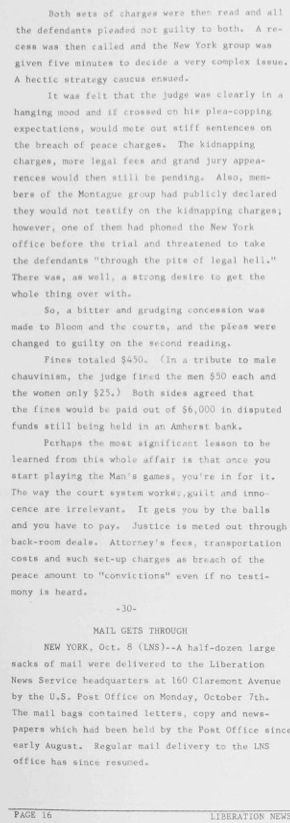

Here’s how LNS covered the settlement of the charges resulting from the LNS split that summer:
One New Left historian remembers Sheila in 1968 as a hard-core radical:
By 1968 important new elements were joining the ranks of the disillusioned. Business, much of it having assumed a partial and tentative membership in the liberal coalition, began to fear the inflation caused by the war. An antiwar group composed of Wall Street business executives, including Marriner Eccles, chair of the Federal Reserve Board under Presidents Roosevelt and Truman, took out an ad in the New York Times opposing the war on grounds it termed practical.
One antiwar activist, Sheila Ryan, attacked Eccles for owning mining operations that might conceivably benefit from the war’s end: evidently since he was not openly on the side of Hanoi and the National Liberation Front he had to be on Johnson’s. Ms. Ryan and some other members of the New Left had come to believe that only mass violence by urban guerrillas would end the evil sway of United States imperialism. Appearing to dislike Eccles and such liberals as Arthur Schlesinger more ardently than they did Johnson, they took as their hero the Argentine-Cuban revolutionary Ernesto “Ché” Guevara.
— In “Making Peace With the 60s“, by David Burner, Princeton University Press, 1996, page 208.
Here’s how the New York Times covered the LNS split in August 1968:
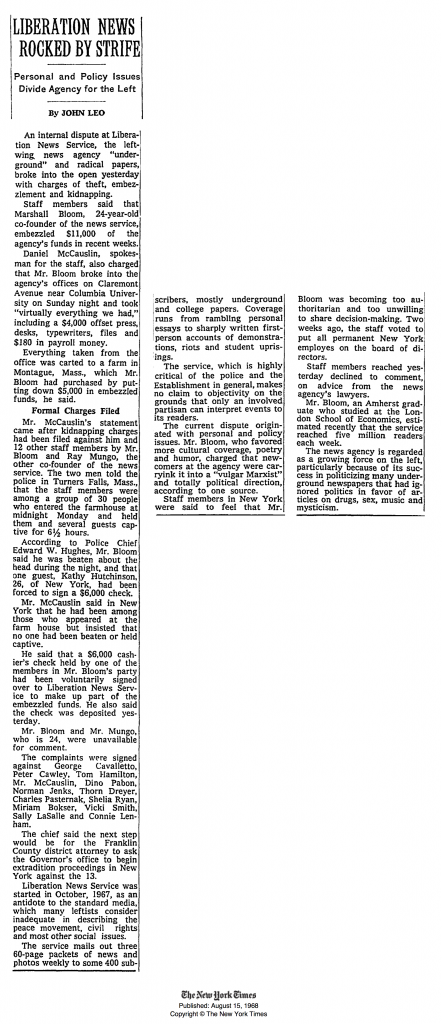
(Available at NYTimes.com) (PDF Version)
And here was the follow-up piece the next day:
Sheila was a passionate believer in democratic participation:
Others shared similar concerns. One was Sheila Ryan, a reporter for the Washington Free Press who began writing pieces for LNS in early 1968 after serving a harrowing six-month jail sentence for having sat in at the White House. Although hardly a cookie-cutter conformist, by the wild standards set by Bloom and Mungo, Ryan may have seemed culturally conservative. She had attended Catholic University, where she’d only rarely smoked marijuana (“because we didn’t have that much time to”), and she always knew that eventually she wanted to become a wife and a mother. Meanwhile, having steeped herself in the civil rights movement, Ryan was impressed with that struggle’s emphasis on democratic participation and consensus building. Her idea of a good leader, she said, was one “who would facilitate the democratic process and really allow people to come together and refine their ideas, and help the best ideas… emerge.” By contrast, she perceived an altogether different approach at LNS, whereby people clustered sycophantically around Bloom. Too often, the group’s accomplishments could be traced to a single individual’s inspiration, rather than the whole group’s collective effort.
— From Smoking Typewriters, John McMillian, Oxford University Press, 2011, page 147-148
From the middle of 1968 through early 1970, Sheila was a member of the collective that ran Liberation News Service, or LNS, which was an alternative press service for underground and new left publications.

Sheila in conversation with Rosa Borenstein, another LNS member, in a photo from 1969 or 1970.
For more information about LNS, you can see the brief overview in Wikipedia, an essay about “the new media” published by LNS in 1969, or Allen Young’s essay from 1990. The 1972 fundraising letter from Jack Newfield, Nat Hentoff, I.F. Stone, and William M. Kunstler to the New York Review of Books also details their impact.
Many of the LNS packets from August 1968 through 1977 are available at Archive.org. (The collection of packets from 1967 through 1968 was taken by LNS founders Bloom and Mungo and is now archived at the University of Massachusetts.) The LNS photo archive is held at NYU. The LNS research library is archived at Temple University in Philadelphia.
While Sheila was in jail in the fall of 1967, Liberation News Service was started in Washington D.C., and ended up sharing an office with the Washington Free Press:
Sheila Ryan[‘s] first encounter with LNS came as part of the Washington Free Press that shared space with LNS at 3 Thomas Circle as early as December 1967.
— From Living the Movement: Liberation News Service, Montague Farm, and the New Left, 1967-1981, Dissertation by Blake Slonecker
Following her release from jail in January 1968, Sheila wrote for both the Washington Free Press and LNS before moving to New York:
In early 1968, Sheila Ryan walked free from the Washington Women’s House of Detention, where she had been jailed for six months for her role in a White House sit-in to protest federal indifference to the civil rights crisis in Selma. The dislocation of her prison term had been jarring, yet her release provided an opportunity for her to make a clean break of affairs and to pursue a new direction in life. A longtime staffer at the Washington Free Press, Ryan at first returned to the participatory environment where she had come of age as an underground newsperson before her arrest. But she also began to write stories for Liberation News Service (LNS), and she quickly became enthralled by the prospect of speaking to a national audience. So when LNS packed up its equipment to leave Washington in July 1968, Ryan joined the organization in its move to New York.
— From A New Dawn for the New Left: Liberation News Service, Montague Farm, and the Long Sixties, by Blake Slonecker, Palgrave Macmillan, 2012.
Here’s another version of that story:
Just as LNS packed up its equipment to leave Washington for good, Sheila Ryan—a longtime staffer at the Washington Free Press who had published occasionally in LNS—decided to join them in their move to the Big Apple. Recently released from the Washington Women’s House of Detention—where she had been jailed for six months for her role in a White House sit-in to protest federal indifference to the civil rights crisis in Selma—Ryan was but one more coal thrown under the tinderbox of LNS’s new basement headquarters in Harlem.
— From Living the Movement: Liberation News Service, Montague Farm, and the New Left, 1967-1981, Dissertation by Blake Slonecker
In February, 1968, Sheila traveled to Cuba as part of an SDS delegation.
The trip was described in an FBI summary:


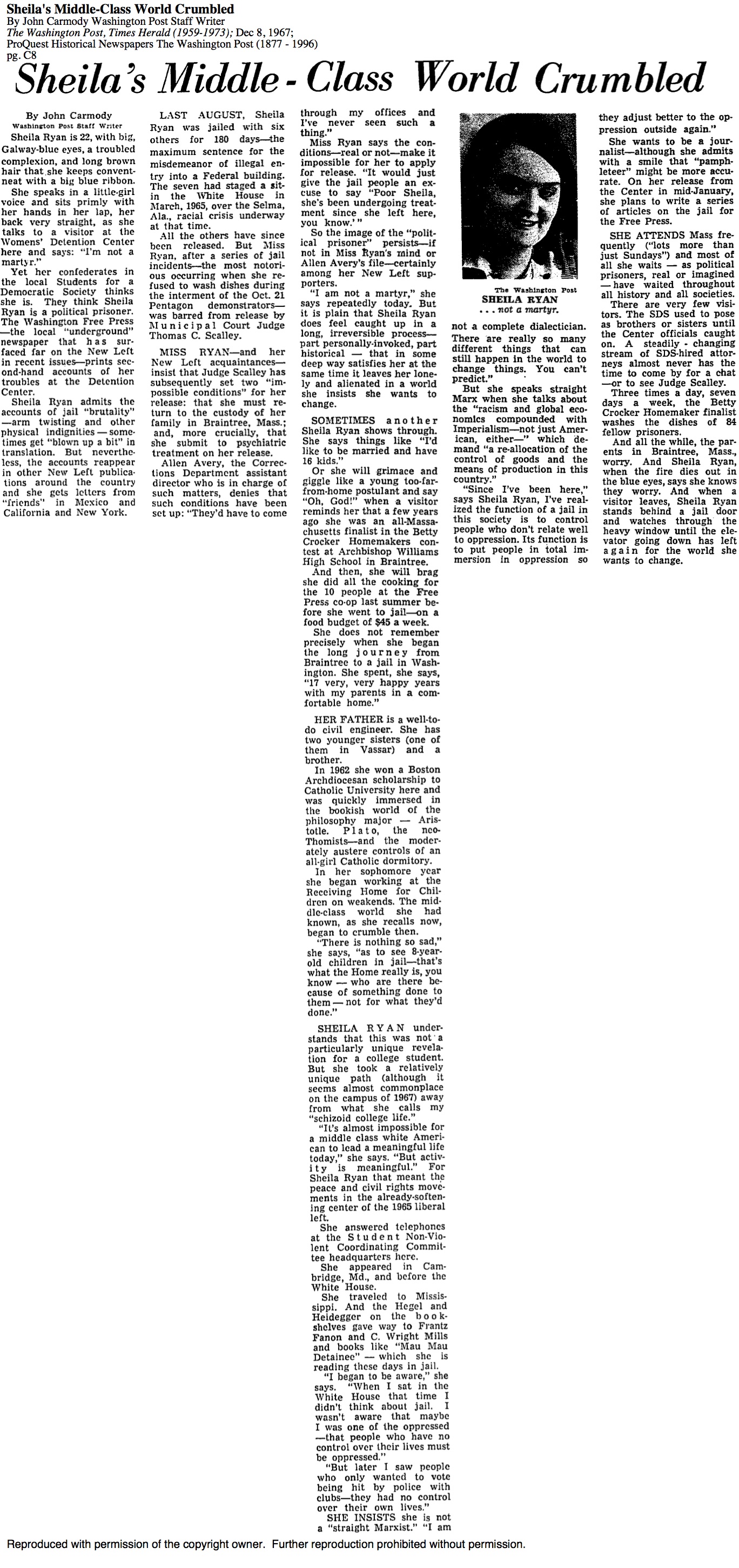
This article in the Washington Post in December 1967 is based on an interview while Sheila was in jail.

The jail-house photo is imperfect, but recognizably Sheila:

(Original Layout) (PDF Version)
This article was also syndicated to The Milwaukee Journal a week later.
We have not been able to locate an online copy of this article, which has been cited in a couple of recent New Left History books, so all we have to go on is the title:
Margie Stamberg, “Sheila Ryan Beaten by Prison Guard,” Washington Free Press, November 23, 1967, 4
In the summer of 1967, Sheila began her six-month jail term at the Washington Women’s House of Detention.
(We don’t know the details behind the year-long delay between the appeal and the start of her term, although this may have been intended to allow her to finish her college degree at Catholic University.)
Sheila was an uncooperative and troublesome prisoner. All of the other protestors who received six-month sentences were released in less time, but Sheila’s behavior earned her additional time:
She was released in January 1968.
Cathy Wilkerson, one of the Weathermen who survived the March 6, 1970 explosion in Greenwich Village, had met Sheila when she first moved to Washington D.C. in 1967:
Sheila Ryan wrote about the connections between Democratic Party leaders and the Institute of International Labor Research, an organization that designed and set up “left” parties in seventeen Latin American countries, supporting them with funds from the CIA. The leaders of these parties then helped the United States to orchestrate the installation of politicians loyal to the United States, like Bosch in the Dominican Republic, without showing their hand too obviously. WFP writers also researched connections between local political people, including a few in the peace movement, and CIA-funded foundations and institutes. Through these articles, and others published in Ramparts magazine during the same period, I learned to search for the funding behind any foundation, organization, or institute and to stay suspicious of the hidden hand of the CIA, which in the name of democracy often sought to undermine local grass-roots forces.
… Peter Henig’s friend from Earlham, Marilyn McNabb… like Peter and Sheila, was drawn to the task of teasing apart the connections between the various circles of power in the country, and in so doing, showed how these circles knowingly served each other.
— From Flying Close to the Sun: My Life and Times As a Weatherman, By Cathy Wilkerson, Seven Stories Press 2007, p 136-137.
During a delay after sentencing, while she was finishing her college degree, Sheila began writing articles for the Washington Free Press, an “underground” newspaper.
According to Wikipedia:
The Washington Free Press was a biweekly radical underground newspaper published in Washington, DC, beginning in 1966, when it was founded by representatives of the five colleges in Washington as a community paper for local Movement people. It was an early member of the Underground Press Syndicate. Starting in Dec. 1967 they shared a three-story house in northwest Washington with the Liberation News Service, the Washington Draft Resistance Union, and a local chapter of the anti-draft group Resistance.
Around this time, she also became involved in the Students for a Democratic Society.
There was an appeal following the sentencing that was eventually denied.
The ABA Journal provides a description of the legal maneuvering involved.
Here’s the final denial:
WHITTLESEY v. UNITED STATES
The New York Times reported on Sheila’s sentencing on June 23, 1965:
They were released on $300 bond while they filed an appeal:
(From Civil Liberties Docket, November 1965)
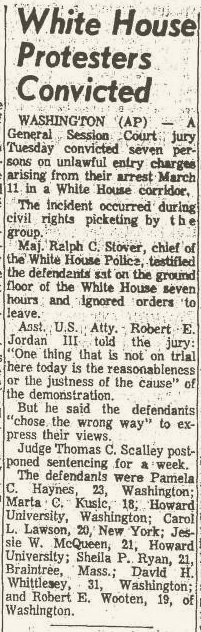
The sit-in protestors were tried and convicted three months later:
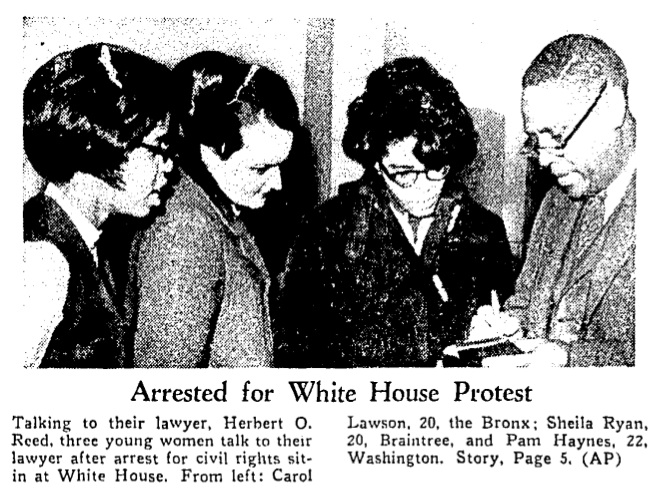
This photo from the Boston Globe on March 12, 1965 shows Sheila and two other women talking with their lawyer following their arrest at the White House.
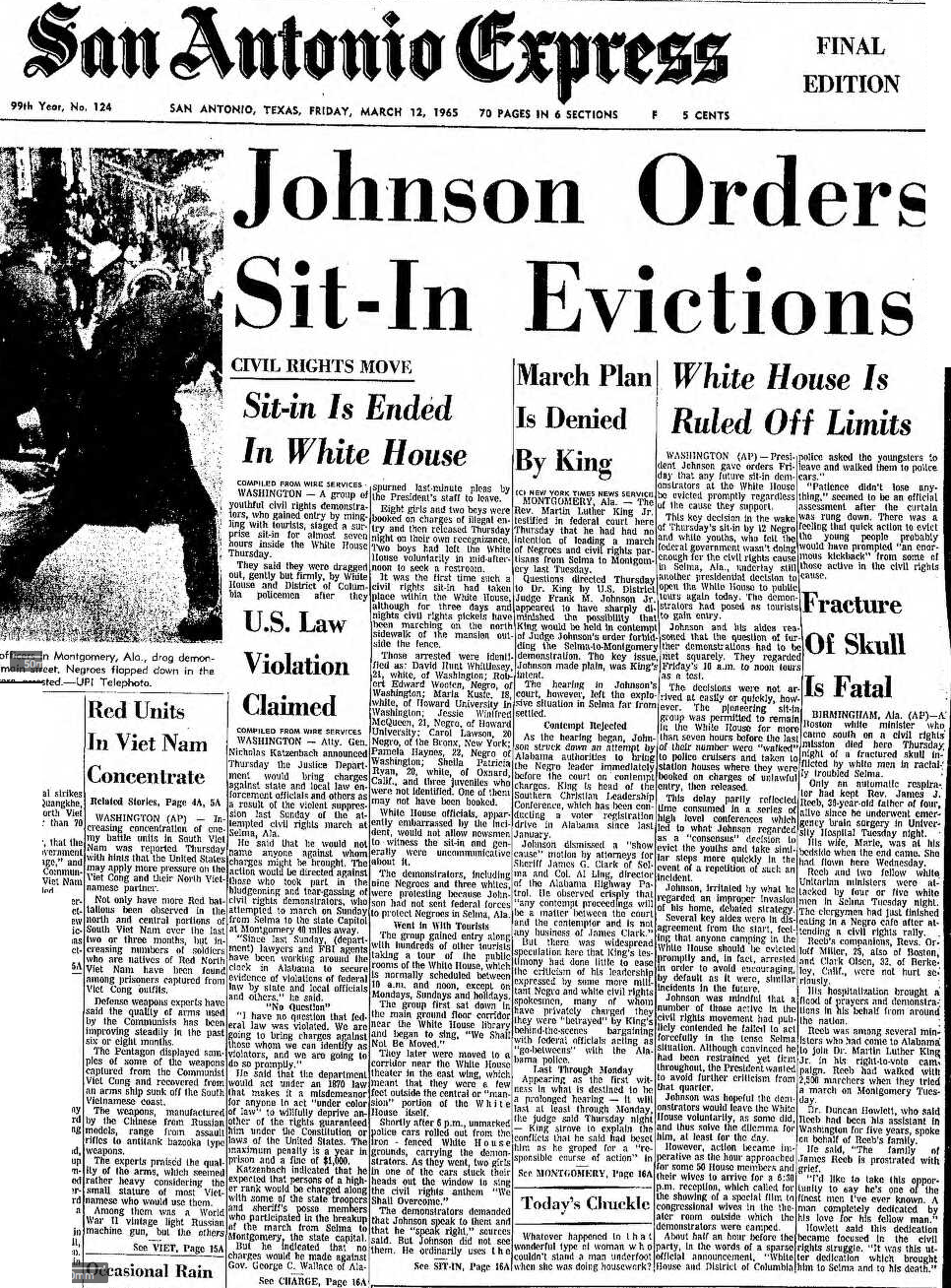
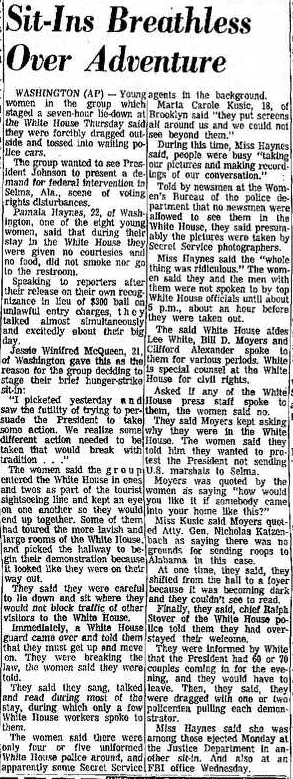
The protest was reported in the Long Beach Press Telegram
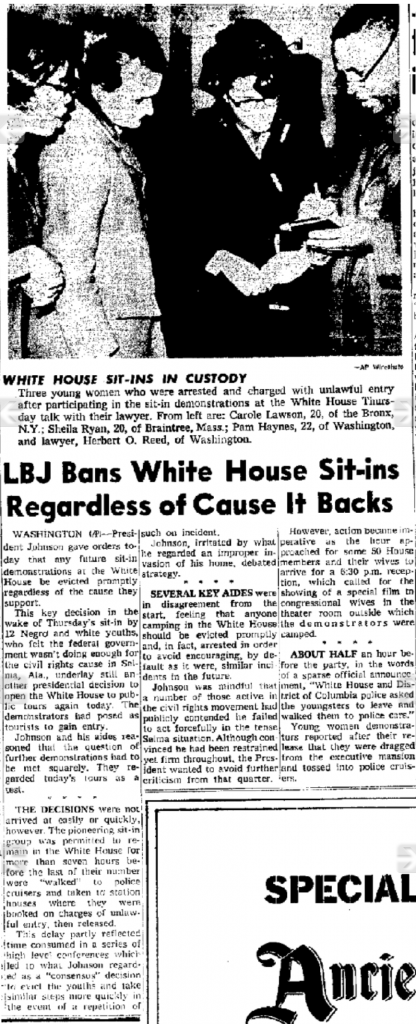
— From the Press Telegram, Friday, March 12, 1965, page 2.
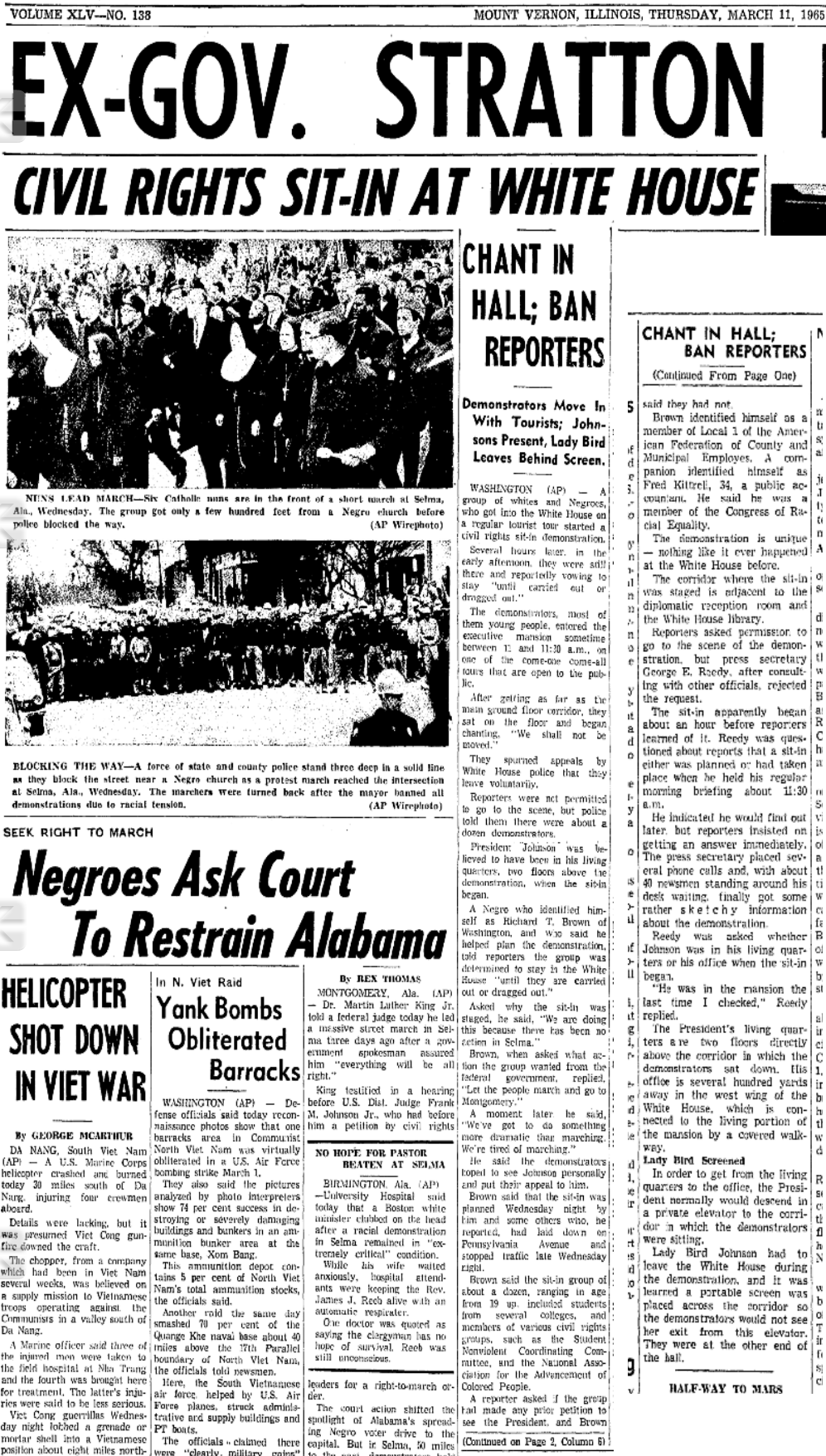
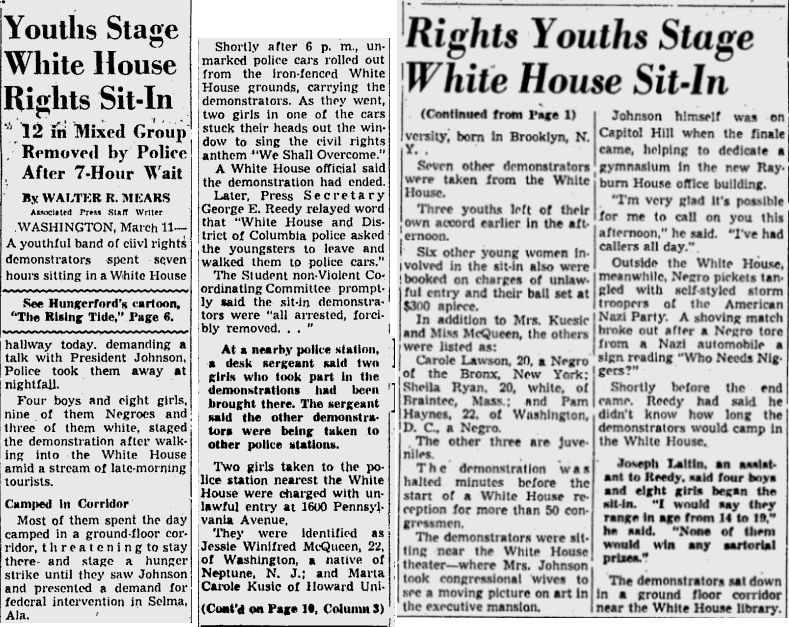
The sit-in was front-page news in Charleston, West Virginia, which ran the same AP story:


— From “White House Seiged by Sit-In“, the Charleston Gazette, Friday March 12, 1965, Front page and page 27.
The sit-in was front-page news in the Pittsburgh Post-Gazette on March 12, 1965:
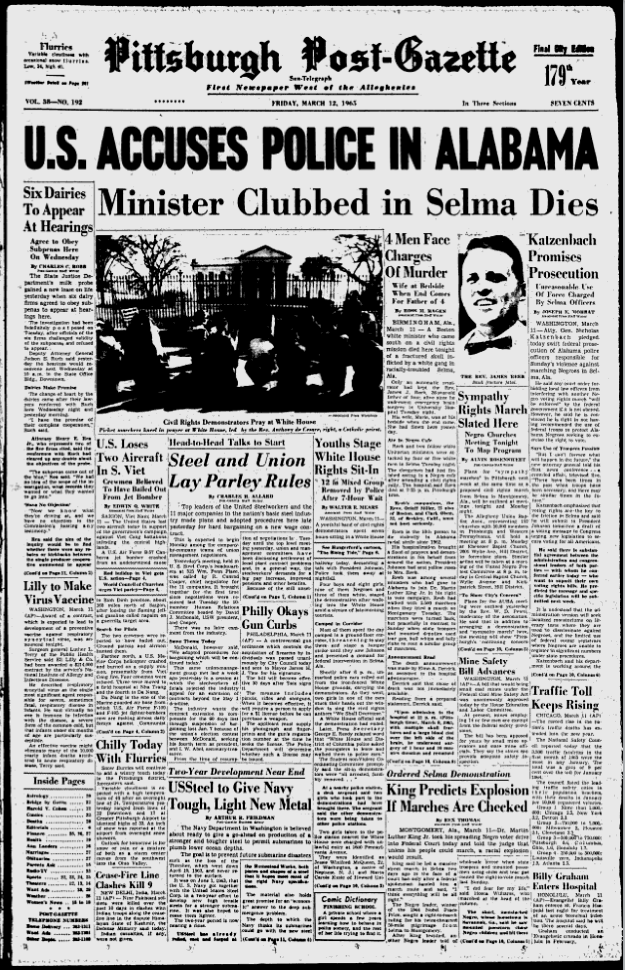
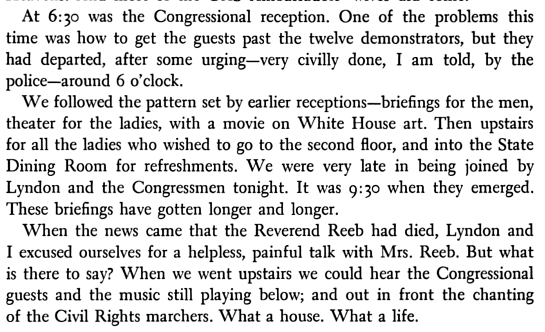
Here’s how “Lady Bird” Johnson, the First Lady, described the day in her official diary:

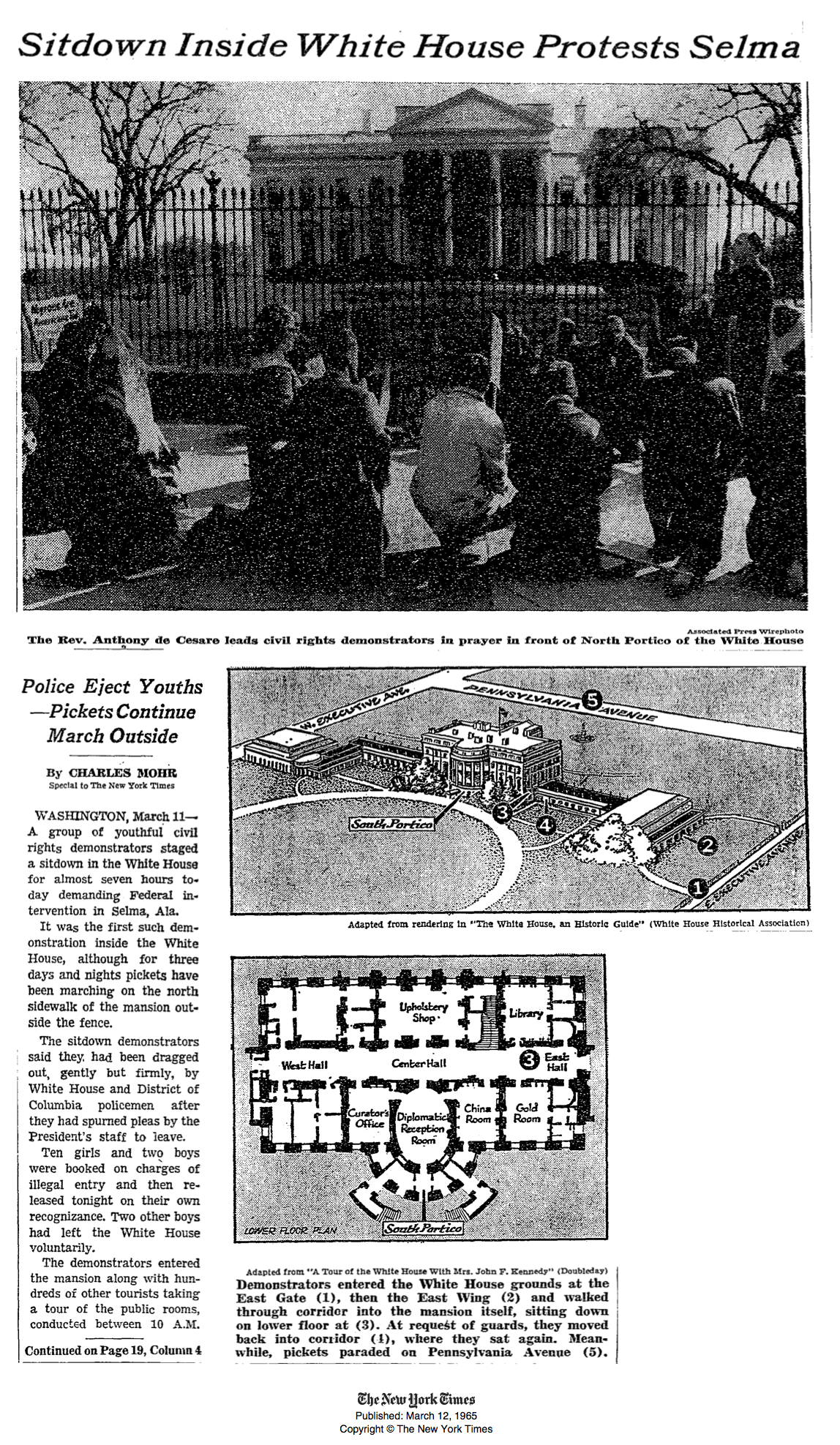
The protest was reported on the front page of the New York Times: “Sitdown Inside White House Protests Selma; Police Eject Youths — Pickets Continue March Outside”

The LBJ Presidential Library has released copies of the official White House diary kept during the Johnson administration.
The entry for March 11, 1965 contains multiple entries regarding the sit-in, many of which feature Rufus Youngblood, a US Secret Service agent who had leapt to protect Johnson during the assassination of JFK, and was put in charge of the White House Secret Service detail when Johnson became President. The log also notes the involvement of Presidential advisors Bill Moyers, Jack Valenti, Cliff Alexander, and Lee White in the discussions that day.
11:20 Rufus Youngblood, USSS, went to the second floor to see the President. He was on the telephone, so he sent a note into the President by way of Ken Gaddis to the effect that 12 demonstrators were sitting down on the ground floor.